
AI shopping assistant: the guide for stores that sell complex products
An AI shopping assistant helps customers find, choose and buy the right products through conversation. For stores with technical ranges and trade customers, it is the closest thing to putting your best salesperson on every page, every hour of the day.
What an AI shopping assistant does
Understands the need
Customers describe a job or a problem in their own words. The assistant asks the questions a good salesperson would.
Recommends the right products
From your catalog, with reasons, alternatives and what goes with them.
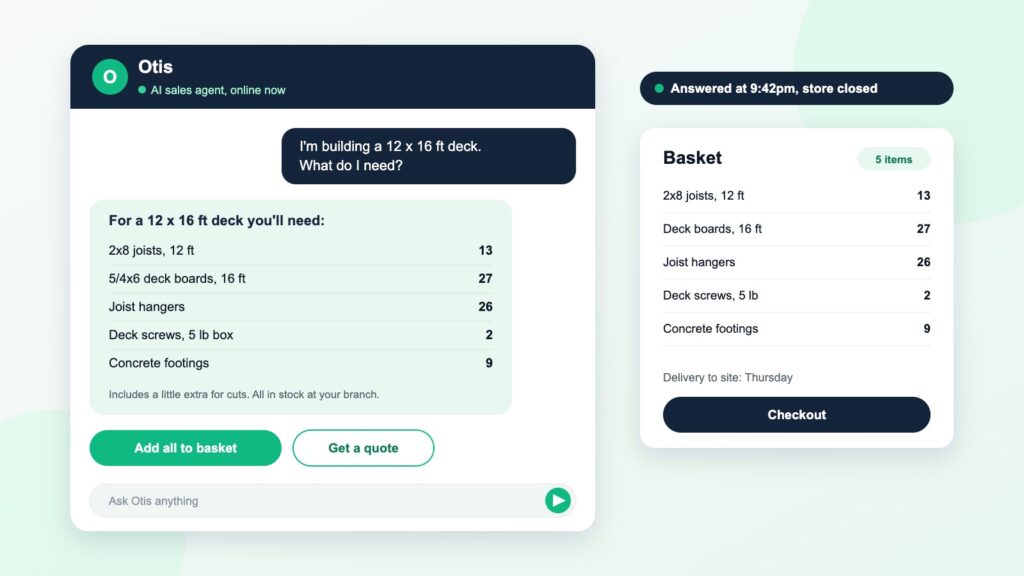
Works out quantities
Area, length, coverage and pack sizes calculated, so customers buy enough first time.
Checks price and stock
Live from your systems, including account pricing for logged in customers.
Builds the basket
Items go straight into the basket, ready to check out.
Hands over when needed
Complex quotes go to your team with the whole conversation attached.
AI shopping assistant vs chatbot vs site search
| Feature | Chatbot | Site search | AI shopping assistant |
|---|---|---|---|
| How customers ask | Set menus and scripted questions | Keywords and filters | Plain language, with follow up questions |
| Product knowledge | Scripted answers | Matches text | Reasons over your product data |
| Live price and stock | Rarely | Sometimes | Yes, from your systems |
| Builds a basket | No | No | Yes |
| Typical outcome | Deflects support questions | Shows a list of results | Sells |
The difference matters because most lost sales on technical stores are not search failures. They are unanswered questions. Read more in AI agent vs chatbot.
Where shopping assistants make the biggest difference
Technical and trade products
Building materials, electrical, plumbing, tools and parts, where choosing wrong is costly.
Large catalogs
Tens of thousands of SKUs where filters and search leave customers stuck.
Project purchases
Jobs that need several products in the right quantities.
Out of hours buying
Customers who plan in the evening and want an answer now, not tomorrow.
Examples of AI shopping assistants
Large retailers have made the idea familiar. Amazon launched its Rufus shopping assistant in 2024, and many retailers now let shoppers ask questions in plain language. For most stores the opportunity is narrower and more valuable: helping customers with the products that need explaining.
Otis is an AI shopping assistant built for trade and B2B stores. On a UK builders merchant’s website it took conversion from 1% to 12.2% and lifted average order value from £247, because it recommends the whole job rather than a single item.
How to choose an AI shopping assistant
Grounded in your data
Answers must come from your catalog and policies, not the open internet.
Connected to price and stock
Without live data an assistant can describe products but cannot sell them.
Able to act
Adding to basket, opening accounts and placing orders is what turns chat into revenue.
Works on your platform
Shopify, BigCommerce, Adobe Commerce, WooCommerce or custom, without a rebuild.
Measured on sales
Judge it by conversion, order value and revenue, not chat volume.
Easy to steer
You control tone, rules, promotions and when it hands over to a person.
Setting one up
Start with your best selling ranges and the questions your team answers most often. Connect the assistant to your product data, prices and stock, set the rules for what it can offer and when it hands over, then put it where customers hesitate: category pages, product pages and search results. Review conversations weekly in the first month and fix the data gaps they reveal.
How an AI shopping assistant works
Behind the conversation, four parts work together.
Your product data
Titles, specifications, attributes, documents and images, cleaned and structured so the assistant can reason over them.
Live systems
Price, stock and customer data read from your ERP or ecommerce platform at the moment of the question.
The language model
Understands what the customer means, asks clarifying questions and explains its recommendations in plain language.
Guardrails and actions
Rules for what it can say and offer, plus the actions it can take, such as adding to basket, creating a quote or handing over to a person.
For each question the assistant retrieves the relevant products and facts and answers only from them. That grounding is what separates a useful shopping assistant from a general chatbot that sounds confident and gets the details wrong.
What an AI shopping assistant costs
Pricing models fall into three groups.
| Model | How it works | Best for |
|---|---|---|
| Per conversation or message | A fee for each chat or message handled | Stores testing with low volume |
| Monthly subscription | A fixed fee by tier, sometimes with usage limits | Predictable budgets |
| Performance based | A share of the sales the assistant brings in | Stores that want cost tied to results |
Otis pricing tracks the sales it brings in. See pricing and how it works.
Measuring results
Conversion rate
Sessions with an assistant conversation that end in an order, compared with sessions without.
Average order value
Whether recommendations are completing the job.
Out of hours revenue
Orders placed while your team is offline.
Assisted revenue
Sales that followed a conversation, tracked through to the order.
Containment
Questions answered without a person, and how often handovers happen.
Gaps found
Questions the assistant could not answer, which point to missing product data.
Common mistakes when adding an AI shopping assistant
Launching on the whole catalog at once. Start with the ranges where customers ask the most questions, prove it there and expand.
Hiding it. An assistant behind a small corner icon gets ignored. Put it where customers hesitate, on search results, category pages and product pages, with prompts that match the page.
Measuring chats instead of sales. A busy assistant that does not sell is a cost. Track conversion and order value from day one.
Ignoring the conversations. Customer questions are the best research you will ever get. Review them weekly and fix the product data and policies they expose.
AI shopping assistant for B2B and trade
Trade buyers want speed and accuracy more than inspiration. A B2B shopping assistant needs to recognize logged in accounts, apply their pricing and terms, handle part numbers and units of measure, and know when a job needs a quote rather than a basket. Those features matter most to distributors, merchants and dealers, and they are where retail focused assistants usually fall short. See ecommerce for distributors.
Privacy and data
A shopping assistant should use only the data it needs to help the customer and keep conversations secure. Ask any vendor where data is hosted, how long conversations are kept, whether your data is used to train models outside your account and how customers can ask for their data to be removed. See how Otis handles this on security and architecture.
AI shopping assistant use cases
Finding the right product
The customer describes the job and the assistant narrows thousands of products down to the right few.
Comparing options
Clear differences between two or three products, and which suits the customer’s job.
Working out quantities
Coverage, waste and pack sizes calculated from the customer’s measurements.
Checking compatibility
Whether a part fits, what else is needed and what replaces a discontinued item.
Reordering
Repeat items found from order history and added to the basket in seconds.
Getting a quote
Larger jobs priced and sent as a quote for approval, with a person copied in where needed.
Building the business case
The return from an AI shopping assistant comes from three places: more visitors converting, larger orders because jobs are completed, and orders captured while your team is offline. Start from your current traffic, conversion rate and order value, then model modest improvements in each. Compare that with the cost of the assistant and the time your team spends answering the same questions by phone and email. Try the Otis ROI calculator with your own figures.
AI shopping assistant vs sales staff
A good salesperson builds relationships, negotiates and handles the unusual. An AI shopping assistant answers every visitor at once, never forgets a specification and works through the night. The strongest setups use both: the assistant handles volume and routine questions, and passes the customers who need a person to your team, with the conversation and a draft basket already prepared.
Does an AI shopping assistant affect SEO?
Not if it is added properly. The assistant loads alongside your pages and does not replace the content search engines read. It can help SEO indirectly, because the questions customers ask show you exactly what your product pages and guides are missing. Add those answers to the pages and both rankings and conversion improve.
Build or buy?
Some large retailers build their own assistants. For most merchants and distributors, buying is faster and cheaper, because the hard parts are not the language model but the connections to product data, pricing, stock and orders, and the rules that keep answers accurate. Ask how long a vendor needs to go live on your catalog, and what you will need to provide.
Results from a live deployment
Figures from a UK builders merchant running Otis on its website.
1% to 12.2%
Website conversion rate before and after Otis went live.
55%
Of Otis orders placed out of hours, when no one was answering the phones.
£247
Average basket, because Otis recommends the whole job, not one item.
Common questions
What is an AI shopping assistant?
Software that talks with customers on an ecommerce site, understands what they need and helps them choose and buy the right products, using the store’s own catalog, prices and stock.
Is an AI shopping assistant the same as a chatbot?
No. A chatbot mostly answers set questions. A shopping assistant reasons over your products, checks live data and builds the basket.
Does an AI shopping assistant work for B2B?
Yes, and often better than in retail, because B2B products are technical and buyers value fast, accurate answers. It needs to handle account pricing and trade accounts.
How much can an AI shopping assistant lift conversion?
It depends on the store and range. On a UK builders merchant’s site, Otis lifted conversion from 1% to 12.2%. If Otis does not lift your conversion in 90 days, you get your money back.
How does an AI shopping assistant work?
For each question it retrieves the relevant products and facts from your catalog and systems, uses a language model to understand the request and explain its answer, and takes actions such as adding items to the basket.
How much does an AI shopping assistant cost?
Vendors charge per conversation, by monthly subscription or on performance. Otis pricing tracks the sales it brings in.
See Otis on your own store
Book a call and we will show Otis working on your own catalog. If Otis does not lift your conversion in 90 days, you get your money back.