
Hardware store software: POS, inventory and selling online
A hardware store carries tens of thousands of small items, sells to homeowners and trades, and competes with big box stores online. The right software keeps the counter fast, the shelves right and the website selling. Here is how to choose it.
See Otis talking to your customers
This is the search bar and Otis on a hardware store's website, fixing a dripping tap from a photo at 7:36pm on a Sunday.
Everything for the home and garden
Search by product or describe the job
Or ask Otis to
It's this mixer and it won't stop dripping
What hardware store software needs to do
Fast point of sale
Barcode scanning, bulk items sold by weight or length, keys, paint tinting and rentals, all at a busy counter.
Item level inventory
Tens of thousands of SKUs, vendor catalogs, reorder points and seasonal stock.
Trade accounts
Charge accounts, contractor pricing and statements for your pro customers.
Wholesaler feeds
Catalog, pricing and replenishment loaded from your wholesaler or buying group.
Loyalty and marketing
Customer history, offers and email that bring homeowners back.
Ecommerce
A website that shows real stock and lets customers buy or reserve online.
Hardware store POS and software options
| System | Typical fit | What to know |
|---|---|---|
| Epicor Eagle | Independent hardware stores, home centers and lumber yards | Long established in North American hardware retail. Otis for Epicor Eagle |
| ECI Spruce | Hardware stores with a lumber yard or contractor trade | POS and back office aimed at hardware and LBM. Otis for Spruce |
| Paladin POS | Independent hardware, farm and garden stores | POS and inventory built for independent retailers. |
| Epicor BisTrack | Larger hardware and building supply businesses with a trade focus | Dealer workflows, special orders and delivery. Otis for BisTrack |
| General retail POS such as Lightspeed, Shopify POS or Square | Small stores with simpler ranges | Easy to start with, but trade accounts and hardware specific features are limited. |
The best POS software for a hardware store is the one that matches your sales mix. A retail heavy store and a store doing half its sales to contractors need different things.
How to choose
Map your sales mix
Retail heavy stores need a fast, simple POS. Stores with strong contractor sales need accounts, quotes and delivery.
Check vendor integration
Make sure catalog and price updates from your wholesaler load automatically, or your team will lose hours to price files.
Test a busy hour
Run a real rush in the demo: a key cut, paint mixed, a contractor on account and a return.
Plan for online
Ask how the system connects to ecommerce and AI tools, and what the API costs.
Selling online as a hardware store
Customers start online even when they buy in store. They search for how to fix a leak or which screws suit their decking, then go wherever gives them a clear answer and shows the item in stock.
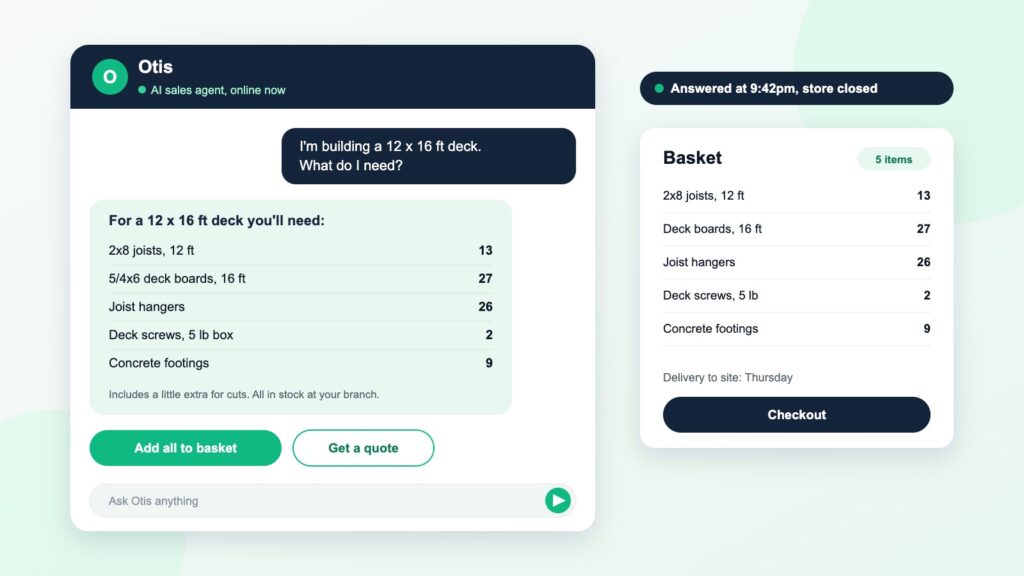
Big box retailers win that moment with scale. An independent can win it with expertise. Otis puts your counter knowledge on your website: it answers the question, recommends the right products and quantities, checks your stock and takes the order or reservation at any hour.
Hardware store marketing that converts
Answer project questions
Guides and an assistant that answers how to questions turn search traffic into baskets.
Show live stock
In stock today is your edge over online only sellers. Show it on every product.
Follow up on quotes
Bigger projects need a nudge. Send the quote, then follow up while the job is still being planned.
Hardware store inventory management
Hardware stores live or die on inventory: too much ties up cash, too little loses the sale to a big box store. Good hardware store software sets reorder points by season, flags slow movers, handles vendor returns and matches your wholesaler’s catalog so new items load without retyping. Ask how each system handles bulk items, special orders and items sold by weight or length, because that is where general retail systems struggle.
Hardware store POS hardware
Scanners and scales
Handheld scanners for large items and scales for bulk fasteners and chain.
Label printers
Shelf labels that update with price changes save hours every week.
Card terminals
Integrated payments so the till and the card machine always agree.
Mobile devices
Tablets for the yard and the floor, so staff can check stock and take orders anywhere.
Hardware store ecommerce: where to start
You do not need every item online on day one. Start with the categories customers research most, such as fasteners, plumbing repairs, paint and outdoor projects, with accurate stock and clear pickup options. Add an assistant that answers project questions, then expand the catalog as you learn what sells online.
Competing with big box stores online
You will not beat a national chain on range or advertising budget. You can beat it on advice, availability today and service. Make those visible online: real stock, same day pickup, expert answers and the trade knowledge your counter staff carry. An AI agent puts that knowledge on every product page, at any hour.
Hardware stores in Australia, New Zealand and South Africa
Independent hardware stores outside North America often belong to a buying group with its own systems, and many run local POS software. The online challenge is the same everywhere: customers research before they buy and choose whoever answers first. Otis works alongside the system you run.
Results from a live deployment
Figures from a UK builders merchant running Otis on its website.
1% to 12.2%
Website conversion rate before and after Otis went live.
55%
Of Otis orders placed out of hours, when no one was answering the phones.
£247
Average basket, because Otis recommends the whole job, not one item.
Common questions
What is the best POS system for a hardware store?
For independents in North America, Epicor Eagle, ECI Spruce and Paladin are built for hardware retail, with features like bulk items, keys, paint and charge accounts. General retail POS systems are easier to start with but usually lack trade and hardware specific features.
Do hardware stores need ecommerce?
Most customers research online before they visit. Even if you do not ship, showing stock and letting customers reserve or order for pickup wins sales that would otherwise go to big box stores.
Can AI help a small hardware store?
Yes, mainly by answering product and project questions online and outside opening hours, and by recommending the full set of items a job needs.
Does this apply to hardware stores in Australia and New Zealand?
Yes. Hardware and building supplies businesses there face the same shift online, and Otis works with the platforms they use. See AI for building supplies merchants.
What features should hardware store software have?
Fast POS with barcode scanning and bulk items, item level inventory with seasonal reorder points, charge accounts for contractors, wholesaler catalog updates, loyalty and a connection to ecommerce.
See Otis on your own store
Book a call and we will show Otis working on your own catalog. If Otis does not lift your conversion in 90 days, you get your money back.