
Conversational commerce: selling through conversation, at scale
Conversational commerce means buying and selling through conversation: chat on a website, messaging apps, email or voice. AI has turned it from a support channel into a sales channel. This guide explains how it works and where it pays off for B2B and trade sellers.
What is conversational commerce?
The term describes any sale that happens through a conversation rather than by clicking through pages. A customer asks a question, gets an answer, receives a recommendation and completes the purchase, all in the same thread.
Trade businesses have always sold this way. Counter staff and phone teams are conversational commerce. What has changed is that AI can now hold those conversations online, accurately, at any hour and with many customers at once.
Conversational commerce channels
Website chat
An AI agent on product and category pages, where buying decisions happen.
Messaging
WhatsApp and SMS for orders, updates and reorders. See WhatsApp trade ordering.
Quote requests and orders that arrive by email, answered and processed automatically. See AI email agent.
Voice
Phone calls answered by an AI voice agent that can quote and take orders. See AI voice agent.
In store kiosks
Self service at the counter or in the showroom. See Otis Depot.
Social
Questions from social channels turned into conversations that sell.
Conversational commerce examples
A contractor at 9pm
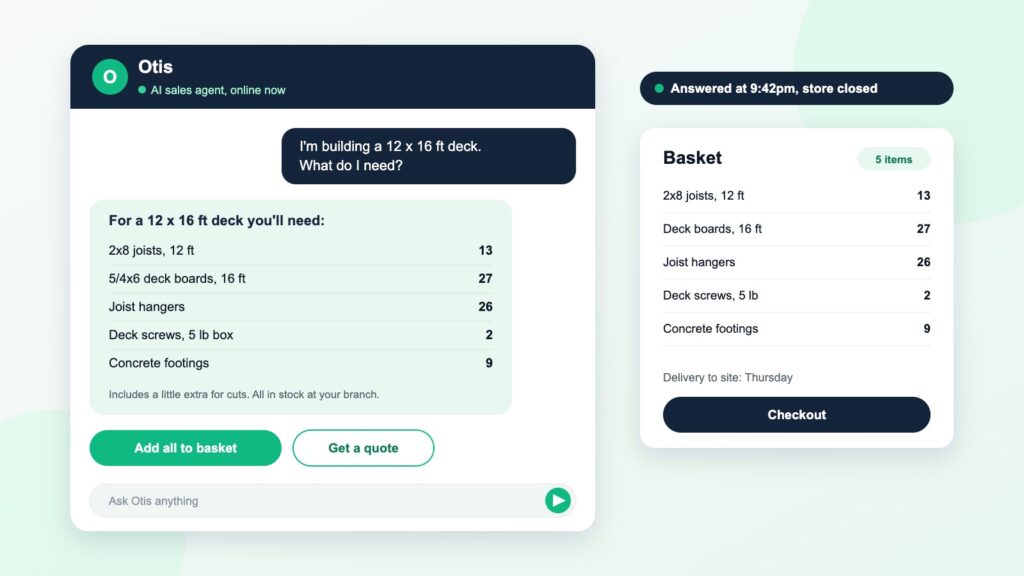
Asks what screws she needs for a new deck. The agent works out the quantity from the deck size, checks branch stock and builds the order for collection first thing.
A homeowner comparing products
Asks which paint suits a bathroom ceiling. The agent explains the difference, recommends a product and adds the right primer and roller.
A trade buyer reordering
Texts a list. The agent matches each line to the catalog, applies account pricing and confirms the order.
A buyer with a technical question
Asks whether a fitting works with a certain pipe. The agent checks the product data and recommends the compatible part.
Benefits for B2B and trade sellers
Sell out of hours
55% of Otis orders at a UK builders merchant were placed out of hours.
Higher conversion
Conversations answer the doubts that make visitors leave.
Bigger orders
Recommendations in context complete the job.
How to get started
Start where conversations already happen: the phone queue, the counter and the contact form. Put an AI agent on your website first, connected to your product data, prices and stock, then extend to email, messaging and voice.
OptiFlow offers Otis for website sales, with email, SMS and voice agents for the other channels. Read more about AI shopping assistants and conversion rate optimization.
Why conversational commerce is growing
Three shifts are pushing more buying into conversation. Customers now expect instant answers at any hour, on whatever channel they happen to be using. AI can hold accurate conversations at scale for the first time, grounded in a business’s own product data, prices and stock. And search itself is becoming conversational, as people ask AI assistants for recommendations instead of typing keywords and clicking through results.
Businesses that can answer in conversation, on their own site and channels, keep the customer. Those that cannot send the customer back to a search box, where a competitor may answer first.
Conversational commerce vs live chat vs chatbots
| Approach | Who answers | Can it sell? |
|---|---|---|
| Live chat | Your staff, during opening hours | Yes, when staff are free and know the products |
| Rule based chatbot | Scripted flows and menus | Rarely, it mainly routes and deflects |
| Conversational AI agent | AI grounded in your data, at any hour | Yes, it answers, recommends, quotes and takes orders |
Most businesses combine them: the AI agent handles most conversations and hands over to live chat or a phone call when a person is needed.
A conversational commerce strategy for B2B
Map the conversations
List the questions, quotes and orders that reach your team each week, by channel and by time of day.
Start with the highest volume
Usually product questions and simple orders on the website.
Connect the data
Product information, pricing, stock and customer accounts must all be available to the agent.
Set the handovers
Decide which requests go to which people, and make sure they receive the full conversation.
Add channels
Extend to email, messaging and phone once the website agent is proven.
Measure revenue
Track orders, conversion and order value from conversations, not just the number of chats.
Getting the data ready
Conversations are only as good as the data behind them. Before launch, check that your best selling products have complete specifications, clear names, accurate stock and correct pricing for each customer type. Write down the policies the agent needs, such as delivery areas, cut off times, returns and account terms. Then let early conversations show you what is missing and fix it weekly.
Conversational commerce on WhatsApp and SMS
Messaging suits repeat trade customers. A contractor who orders the same materials every week would rather text a list than log in to a website. An AI agent can read the message, match each line to your catalog, apply the customer’s pricing, confirm stock and send back a total to approve. Delivery and collection updates go back over the same thread, so the whole order lives in one conversation. See WhatsApp trade ordering.
Voice commerce
Phones still carry a large share of trade orders. An AI voice agent can answer every call at once, take simple orders, check stock and pricing, book collections and pass anything complex to the right person with a written summary. For businesses where the phones ring nonstop at 7am, it removes the queue without hiring. See AI voice agent.
Conversational commerce examples by industry
Builders merchants
Quantities for a patio or extension, delivery to site and trade account applications at any hour.
Electrical and plumbing distributors
Part number lookups, compatibility checks and reorders by text.
Hardware stores
Project advice for homeowners and reservations for collection the same day.
Industrial suppliers
Technical questions answered from data sheets, and quotes for maintenance teams.
Conversational commerce platforms
Platforms fall into three groups: messaging platforms that connect channels such as WhatsApp and SMS, customer service platforms whose AI mainly deflects support questions, and AI sales agents built to sell. For B2B and trade businesses, the deciding factors are whether the platform can use account pricing, live stock and product data, and whether it can create orders in your ERP.
Common pitfalls
A bot that cannot sell. If the agent can only answer questions and never build a basket or a quote, customers still have to call.
No way to reach a person. Every conversation needs a clear route to a human for complex jobs, complaints and big orders.
Data that is not connected. An agent that cannot see price and stock can only give general answers, which buyers quickly learn to skip.
No measurement. Without tracking orders and revenue from conversations, nobody can tell whether the channel is working.
Who should own it
Conversational commerce sits between sales, ecommerce and customer service, which is why it often stalls. Give one person ownership of the agent’s results, with a weekly review of conversations, orders and handovers, and a direct line to whoever maintains product data.
Agentic commerce: the next step
Conversational commerce is moving toward agentic commerce, where AI agents act for both sides. Buyers will increasingly ask AI assistants to find and order products for them, and those assistants will talk to sellers’ systems directly. Sellers with clean product data, live price and stock and an agent of their own will be ready for that shift. See agentic sales with Otis.
Measuring conversational commerce
Conversation to order rate
The share of conversations that end in a purchase.
Revenue per conversation
Total conversational revenue divided by the number of conversations.
Response time
How fast customers get a useful answer, on every channel.
Out of hours share
Orders placed while the team is offline.
Conversational commerce for international sales
For businesses selling across countries and time zones, conversation solves two problems at once: customers get an answer during their own working day, and overnight inquiries are handled before your team arrives. An AI agent can route each conversation to the right regional team and use the pricing and stock for that market, where your systems hold them. Start with your largest overseas market and measure response times and conversion there before expanding.
How to choose a conversational commerce partner
Proven in your sector
Ask for results from businesses like yours, not generic retail case studies.
Connected to your systems
ERP, ecommerce and messaging, with live price and stock.
Able to sell
Baskets, quotes and orders, not just answers.
Clear on data
Hosting, security and who owns the conversations.
What to do next
Pick one channel and one range, connect the data and go live. Review conversations weekly for a month, then expand. The businesses that win with conversational commerce are not the ones with the most channels. They are the ones that answer best on the channels their customers already use.
Results from a live deployment
Figures from a UK builders merchant running Otis on its website.
1% to 12.2%
Website conversion rate before and after Otis went live.
55%
Of Otis orders placed out of hours, when no one was answering the phones.
£247
Average basket, because Otis recommends the whole job, not one item.
Common questions
What is conversational commerce?
Buying and selling through conversation, using chat, messaging, email or voice, often powered by AI that can answer questions, recommend products and complete the sale.
What are examples of conversational commerce?
An AI agent on a website that quotes and builds a basket, ordering by text message, AI handling quote requests by email, and voice agents that take orders over the phone.
Is conversational commerce the same as a chatbot?
A chatbot is one tool. Conversational commerce is the wider approach of selling through conversation, and modern AI agents go far beyond scripted chatbots.
Does conversational commerce work for B2B?
Yes. B2B buying is full of questions, quotes and reorders, which suit conversation better than browsing.
What is the difference between conversational commerce and live chat?
Live chat relies on staff being available. Conversational commerce uses AI and messaging to hold buying conversations at any hour, with people stepping in when needed.
What is agentic commerce?
The next stage of conversational commerce, where AI agents act on behalf of buyers and sellers, finding products, comparing options and placing orders through connected systems.
See Otis on your own store
Book a call and we will show Otis working on your own catalog. If Otis does not lift your conversion in 90 days, you get your money back.