
Ecommerce conversion rate optimization for B2B and trade stores
Most conversion advice is written for fashion and gadgets. Trade and B2B stores lose sales for different reasons: technical questions, quantities, account pricing and customers who plan outside opening hours. This playbook focuses on those.
How to measure ecommerce conversion rate
Conversion rate is orders divided by sessions. For B2B it helps to track a few more numbers alongside it: quote requests, trade account applications, phone orders that started online and average order value. A store that converts fewer visitors into larger, complete orders may be doing better than one that converts more visitors into small ones.
Segment by customer type. Logged in trade customers and first time visitors behave very differently, and blending them hides where the problems are.
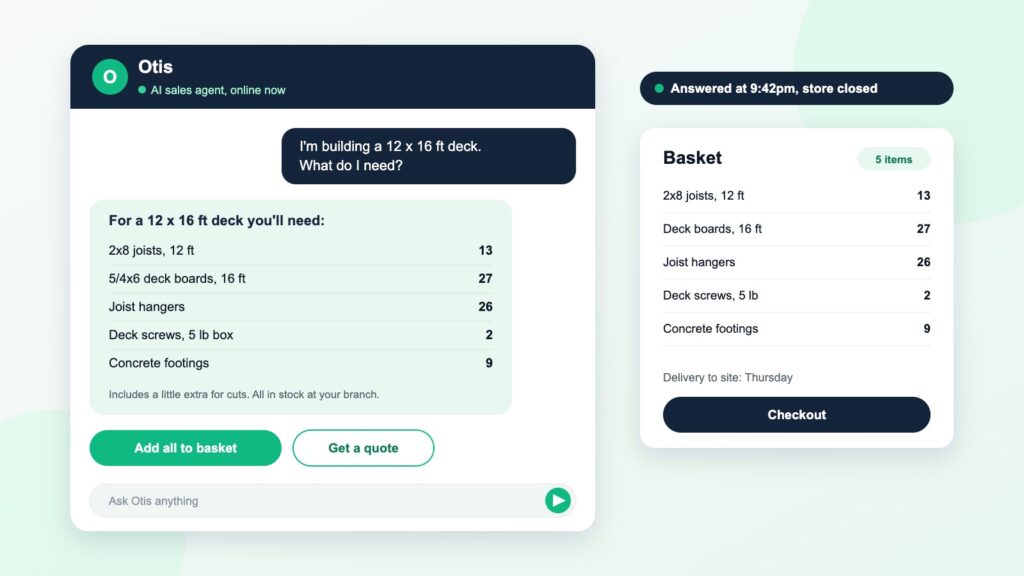
Where trade and B2B visitors drop out
They cannot find it
Search fails on trade terms and part numbers.
They are not sure it is right
Specs and compatibility are unclear, so they call or leave.
They do not know how much
Quantities for a job are left to the customer to work out.
They cannot see their price
List prices put off trade buyers who expect account rates.
Nobody answers
A question at 9pm goes unanswered until tomorrow.
Checkout friction
Account login, delivery slots and payment terms get in the way.
The conversion fixes that matter most
| Fix | Effort | Typical impact |
|---|---|---|
| Instant answers to product questions | Low with an AI agent | High |
| Quantity calculators on project ranges | Low | High |
| Search that understands trade terms | Medium | High |
| Account pricing visible when logged in | Medium | High for trade buyers |
| Stock by branch on product pages | Medium | Medium |
| Guest checkout and saved carts | Low | Medium |
| Better product images and specs | Medium | Low to medium |
The case for AI in conversion rate optimization
Traditional CRO tests layouts and buttons. The bigger lever on a technical store is the conversation that never happens: the customer who had a question and left. An AI sales agent answers that question, works out the quantity and builds the basket, so the visitor converts instead of bouncing.
That is how a UK builders merchant went from 1% to 12.2% conversion with Otis, with 55% of Otis orders placed out of hours.
A 30 day CRO plan
Week 1: find the leaks
Review failed searches, top exit pages and the questions your phone team answers most.
Weeks 2 and 3: fix the top three
Usually search, quantities and instant answers. Add calculators and an AI agent to your best selling ranges.
Week 4: measure
Compare conversion, order value and out of hours orders against the month before.
Want the leaks found for you? Ask for a sales leak audit.
Ecommerce CRO checklist by page
Homepage
A clear statement of what you sell and who for, search front and center, trade login visible, and delivery and collection options shown.
Category pages
Filters that match how buyers choose, stock shown in the listing, bestsellers and a short guide for first time buyers.
Product pages
Full specifications, compatibility, documents and coverage, the account price for logged in buyers, stock by branch, a delivery date and an instant way to ask a question.
Search results
Results for trade terms and part numbers, no dead ends on zero results and alternatives when stock is out.
Basket
Missing items suggested, delivery cost and date clear, and options to save the basket or request a quote.
Checkout
Guest checkout, account terms for trade, few fields, clear delivery slots and visible trust signals.
Product page optimization for technical products
Specifications in a table
Dimensions, materials, ratings and standards in one scannable place.
Documents
Data sheets, installation guides and certificates one click away.
Quantity help
A calculator or agent that works out how many the job needs, including waste.
Compatibility
What it works with, what it replaces and what else is needed.
Delivery and collection
When it can arrive or be collected, from which branch, at what cost.
Instant answers
A way to ask a question and get an answer now, not tomorrow.
Reducing basket abandonment
Most abandoned baskets on trade sites are not lost to price. They are lost to doubt: the wrong quantity, a missing item, an unclear delivery date or a question nobody answered.
Show the total early
Delivery cost and date on the product page and in the basket, not at the last step.
Save and share
Let buyers save baskets, turn them into quotes and send them for approval.
Follow up
Email or text a reminder with the basket and an offer of help.
Help at the point of doubt
An agent that can answer the question that stopped the order.
Trust signals that convert B2B buyers
B2B buyers want evidence that you can deliver: account terms, a returns policy written in plain language, a visible phone number, real reviews and case studies, accreditations and named people they can talk to. Put them where decisions happen, on product pages, in the basket and at checkout, not only on the about page.
How to run conversion tests
Start with research, not guesses. Watch session recordings, read search logs and listen to what customers ask your phone team. Write one hypothesis per problem, such as customers leave product pages because they cannot tell whether a fitting suits their pipe. Then test one change at a time on pages with enough traffic to give a clear answer.
Trade stores often lack the traffic for classic split tests on every page. Where that is true, make the change on one range, compare it with a similar range that stayed the same, and look at the trend over several weeks.
Mobile conversion for trade buyers
Contractors shop on their phones, on site and in the van. Make search and reorder work with one thumb, keep product pages fast, show stock and price near the top and let customers ask a question without filling in a form. An AI agent that understands a typed description is often the fastest route from phone to order.
Why trade sites convert lower than retail
Trade purchases are bigger, more technical and often need approval. Buyers compare, check specifications and ask questions before ordering, and many still finish by phone. That is why trade conversion rates can look low against retail benchmarks, and why the biggest gains come from answering questions and helping with quantities rather than redesigning buttons.
Speed and performance
Slow pages lose buyers, especially on mobile signal at a job site. Compress images, limit third party scripts, cache pages and keep product pages light. Check speed on a real phone, not only on an office connection.
Tools for ecommerce conversion rate optimization
Analytics to see where visitors drop out, session recording to see why, search analytics to see what they could not find, testing tools to prove a change works, and an AI agent to answer the questions that cause people to leave. Most stores already have the first. Few have the last, which is usually where the biggest gain is.
Conversion rate optimization for B2B ecommerce
B2B CRO has its own rules. The buyer may not be the person who approves the order, so quotes and shareable baskets matter. Repeat customers outnumber new ones, so reorder speed matters more than first visit design. And many orders are large and technical, so accuracy beats persuasion. Optimize for the logged in trade buyer first, then for first time visitors.
Using AI to find conversion problems
Every conversation with an AI agent records what the customer wanted, what they asked and where they hesitated. Read together, those conversations show where product pages, policies and search are failing, often more clearly than analytics. Use them as a weekly list of fixes.
Common CRO mistakes
Copying retail tactics
Countdown timers and pop ups annoy trade buyers and rarely help.
Testing tiny changes
Button colors matter far less than missing information.
Ignoring the phone
Calls are a conversion signal. Track which pages they start from.
Optimizing for the wrong visitor
DIY browsers and trade buyers need different paths.
How much can conversion improve?
It depends on where you start. Stores that already answer questions well and show account pricing will see smaller gains from further work. Stores where customers routinely leave to phone or email can see large changes, as the jump from 1% to 12.2% at a UK builders merchant shows. Measure your own baseline first, so you can prove what changed.
Getting help
If you want a second opinion on where your site loses sales, a sales leak audit reviews your search, product pages and inquiry routes and shows the biggest gaps. Fixing the top three usually matters more than a full redesign.
Results from a live deployment
Figures from a UK builders merchant running Otis on its website.
1% to 12.2%
Website conversion rate before and after Otis went live.
55%
Of Otis orders placed out of hours, when no one was answering the phones.
£247
Average basket, because Otis recommends the whole job, not one item.
Common questions
What is ecommerce conversion rate optimization?
The process of increasing the share of visitors who buy, by finding where they drop out and fixing the causes, from search and product information to checkout.
What is a good conversion rate for B2B ecommerce?
It varies widely by sector, traffic mix and how many customers log in. Compare against your own baseline, and track order value and quote requests alongside it.
How can I increase conversion rate quickly?
Answer customer questions instantly, help with quantities and fix failed searches. These address the most common reasons trade buyers leave.
Can AI improve ecommerce conversion?
Yes. On a UK builders merchant’s site, Otis lifted conversion from 1% to 12.2%. If Otis does not lift your conversion in 90 days, you get your money back.
What is a CRO checklist?
A list of the changes most likely to lift conversion on each page type, from search and product information to basket and checkout. Use it to find gaps, then test the biggest ones first.
Why do B2B ecommerce sites convert lower than retail?
B2B purchases are larger and more technical, need approval and often finish by phone. Answering questions and helping with quantities closes much of the gap.
See Otis on your own store
Book a call and we will show Otis working on your own catalog. If Otis does not lift your conversion in 90 days, you get your money back.