
AI product recommendations that customers actually need
Most ecommerce product recommendations are guesses based on what other people bought. The best ones are based on what this customer’s job needs. Here is how AI recommendations work, and how to use them to lift order value without pushing.
Types of ecommerce product recommendations
| Type | How it works | Weakness |
|---|---|---|
| Bestsellers and trending | Shows popular products | Ignores what this customer needs |
| Frequently bought together | Based on past baskets | Repeats habits and misses what the job needs |
| Similar products | Matches attributes | Offers alternatives, not completions |
| Personalized | Uses browsing and order history | Needs plenty of data and can feel random |
| Job based AI recommendations | Reasons about what the task requires | Needs good product data and live stock |
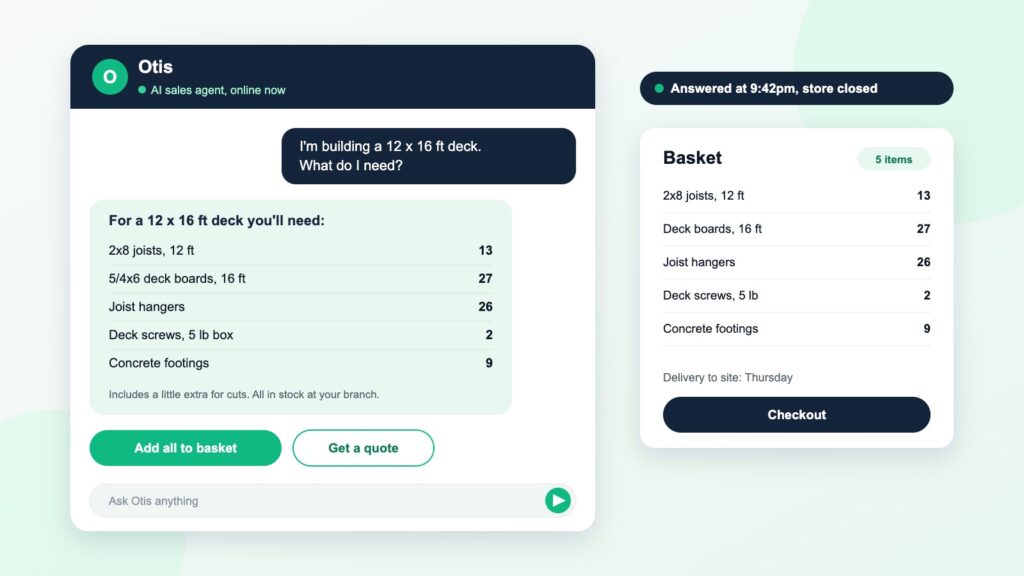
How AI product recommendations work
Traditional engines look for patterns in clicks and baskets. AI recommendations add understanding: the system knows that a customer laying a patio needs a sub base, sand, jointing compound and edging, and in what quantities, even if nobody has bought that exact combination before.
It then checks what is in stock and what the customer pays, and explains why each item is needed. Customers accept a recommendation they understand far more readily than one that appears in a carousel.
Where recommendations lift order value
Completing the job
Fixings, adhesives, sealants and accessories that the main product needs.
Right quantities
Calculated from area or length, with a sensible waste allowance, so the customer does not run short.
Better options
A higher grade or longer lasting product, explained, when it suits the job.
Substitutes
An in stock alternative when the first choice is out.
Consumables
Blades, cartridges and filters that go with tools and equipment.
Reorders
Regular items suggested at the right time for trade customers.
At a UK builders merchant, Otis builds an average basket of £247 by recommending the whole job rather than a single product.
Choosing an AI recommendation tool
Explains its suggestions
Shoppers trust a reason more than a carousel.
Uses live stock and price
Recommending items you cannot supply loses the sale.
Handles quantities
Essential for building, flooring, landscaping and other project ranges.
Measured on order value
Track average order value and attachment rate, not clicks.
Recommendation engines such as Nosto, Dynamic Yield and Algolia Recommend suit large retail catalogs with lots of behavioral data. For technical and project ranges, a conversational agent like Otis recommends in context, during the conversation where the buying decision is made.
Ecommerce product recommendations for B2B
Trade and B2B orders are where recommendations pay most, because jobs need several products in the right quantities and a missed item means a second trip or a lost day on site. Good B2B recommendations respect account pricing, suggest pack sizes that suit the job and never push products the customer does not need. Read more about AI shopping assistants and ecommerce site search.
Where to place product recommendations
Product pages
Accessories and essentials the product needs, shown before the customer adds to basket.
Basket
Anything missing from the job, with quantities, before checkout.
Search results
Related products and in stock alternatives when the exact item is out.
Category pages
Starter bundles for the common projects in that category.
Order confirmation and email
Consumables and next stage items for the same project.
In conversation
Suggestions from an AI agent as the customer describes the job, where they convert best.
How recommendation engines decide what to show
Collaborative filtering looks at what similar customers bought or viewed. It works well with lots of traffic and repeat behavior, and poorly for new products or niche ranges.
Content based filtering matches attributes such as brand, size or material. It finds alternatives easily but does not know what a job needs.
Rules and bundles are set by your team, such as this adhesive with these tiles. They are accurate but slow to maintain across a large catalog.
AI reasoning combines product knowledge with the customer’s request to work out what a task requires, including quantities. It needs good product data but handles new and niche products well.
Recommendations for project ranges
Project ranges show the gap between generic and job based recommendations most clearly. A professional knows what each job needs, and a good AI recommendation does too.
Patio
Slabs, sub base, sand, jointing compound, edging and a weed membrane, in quantities for the area.
Tiled bathroom
Tiles, adhesive, grout, trims, sealant and leveling compound for an uneven floor.
Fence
Posts, panels or rails, post mix concrete, fixings and treatment.
Deck
Boards, joists, deck screws, joist tape and post fixings.
Electrical circuit
Cable, breakers, boxes, connectors and fixings for the run.
Plumbing repair
The valve or fitting, compatible connectors, sealing tape and the right tools.
Cross selling and upselling: the difference
Cross selling adds products that go with the main purchase, such as the adhesive for the tiles. Upselling offers a better version of the same product, such as a longer lasting decking board. Both work when they help the customer finish the job properly. Both fail when they feel like a sales tactic, which is why explaining the reason behind each suggestion matters so much.
How to measure product recommendations
Attachment rate
The share of orders that include a recommended item.
Average order value
Compared between orders with and without recommendations.
Recommendation conversion
Suggestions accepted that become purchases.
Returns
Whether recommended items come back, a sign of poor fit.
Common mistakes with product recommendations
Recommending items that are out of stock, or that the customer cannot buy at their branch. Showing the same bestsellers on every page, so shoppers learn to ignore them. Suggesting a cheaper alternative on a product page and losing margin you would have earned. Ignoring account pricing, so trade buyers see list prices next to their own. And showing too many suggestions at once, which slows the decision instead of completing it.
Getting started with AI recommendations
Pick three to five common projects in your range, such as a patio, a bathroom refit or a fence, and list everything a professional would buy for each. Check that every product on those lists has clean attributes and coverage data. Then let an AI agent recommend from those lists in conversation, and compare order value for those ranges against the rest of the store after a month.
Personalized recommendations without the creepiness
Customers like recommendations that help and dislike ones that feel like surveillance. Explain why each item is suggested, base it on the job they described rather than everything they browsed, and never pressure. For trade customers, reorder suggestions based on their own order history are welcome and save time.
Bundles and kits
Bundles group the products a common job needs into one purchase, such as a fencing kit or a bathroom fitting pack. They work well for frequent projects with predictable contents. AI recommendations go further, adjusting the bundle to the customer’s measurements, preferences and stock, so the kit fits the job instead of the job fitting the kit.
Recommendations in email and reorders
After the order, recommendations keep working. Send consumables and next stage items when the customer is likely to need them, remind trade buyers of regular items before they run out, and suggest the finishing products for a project that started weeks ago. Keep these messages useful and infrequent, or they become noise.
AI product recommendations by industry
Building materials
Sub base, sand, cement and fixings calculated for the area and the job.
Electrical
Breakers, boxes, connectors and cable sized for the circuit.
Plumbing and heating
Compatible fittings, valves and sealants for the pipe type and size.
Hardware
Fasteners, adhesives and tools matched to the material the customer is working with.
Industrial
Spares, consumables and service kits for the equipment the customer runs.
Paint and decorating
Primer, rollers, brushes and the right quantity of paint for the room.
The data recommendations need
Good recommendations depend on a few pieces of product data: accurate attributes such as size, material and compatibility, coverage or yield figures for project products, links between products that are used together, and live stock and pricing. You do not need all of it on day one. Start with your best selling project ranges and expand as you go.
Recommendation engine or AI agent?
A recommendation engine shows suggestions in fixed places on the page, based on patterns. An AI agent recommends during a conversation, based on what the customer has told it about the job. Large retail catalogs with heavy traffic often use both. For technical and project ranges, the conversational approach usually adds more value, because the customer’s own description of the job is the best data you can get.
A simple test plan
Choose two similar ranges. Add AI recommendations to one and leave the other as it is for a month. Compare average order value, attachment rate and returns. If the recommended range wins, roll out range by range, starting with those where customers most often forget something.
Results from a live deployment
Figures from a UK builders merchant running Otis on its website.
1% to 12.2%
Website conversion rate before and after Otis went live.
55%
Of Otis orders placed out of hours, when no one was answering the phones.
£247
Average basket, because Otis recommends the whole job, not one item.
Common questions
What are AI product recommendations?
Suggestions generated by AI that predict or reason about which products a shopper needs, based on their request, behavior and your catalog.
Do product recommendations increase sales?
Good ones do, mainly by lifting average order value. The gain is biggest when recommendations complete a job rather than repeat what others bought.
What is the difference between personalization and recommendations?
Personalization adapts the whole experience to a customer. Recommendations are one part of it: the specific products suggested.
Do recommendations work for B2B?
Yes. B2B orders often need accessories, consumables and the right quantities, which is exactly where AI recommendations help.
Where should product recommendations go on an ecommerce site?
On product pages, in the basket and in conversation with an AI agent, where they complete the job the customer is doing. Order confirmation emails work well for consumables.
How do you measure product recommendations?
Track attachment rate, average order value with and without recommendations, and returns on recommended items.
See Otis on your own store
Book a call and we will show Otis working on your own catalog. If Otis does not lift your conversion in 90 days, you get your money back.